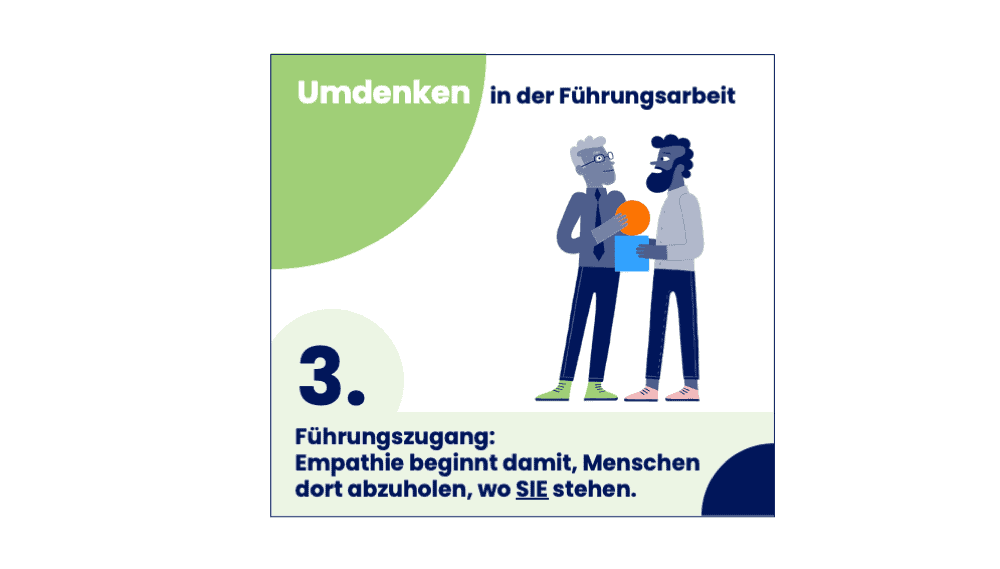
Empathy begins by meeting people where THEY are.
Studies show that empathy in the workplace is positively correlated with job performance. Leaders who manage their employees with empathy are viewed by their superiors as more effective and are also significantly more highly regarded by their employees. Empathy is a fundamental leadership skill for building a safe workplace culture and more trusting relationships.
Let's try something: Think of some leaders you know—how would they answer the following questions?
Have you ever …
- Have you ever heard someone say something, but weren't sure what the other person really meant by it?
- Do you naturally feel a sense of connection with some people, but not with others?
- Been accused of not understanding someone, even though you were listening?
- Have you ever wished you could communicate with others in a way that would help them understand you better?
- Have you ever been told that you lack empathy?
How well do the leaders around you listen from time to time? Do they find it difficult to create a safe space where people feel heard? Can these leaders put themselves in others’ shoes? Are they aware of how their behavior affects other people?
A shift in mindset regarding empathy in leadership can make all the difference. This is the third of eight leadership approaches (“mindsets”) that can significantly improve a leader’s effectiveness.
A Shift in Leadership Thinking – Leadership Approach #3: Empathy starts with meeting people where THEY are.
The Process Communication Model® identifies six different personality types that we all possess. Each personality type has a unique perceptual filter that shapes the way we experience our environment, the situations around us, and how we communicate with others. These perceptual filters can be identified by observing HOW people communicate. PCM shows leaders how to recognize these modes of perception in communication.
Every person has a primary perceptual filter. But we can all learn to recognize and appreciate the other five perceptual filters as well, and use them to expand our empathy.
The six different ways of seeing, perceiving, experiencing, reacting to, and interacting with the world around us are as follows:
Do we experience the world around us through the WAY WE PERCEIVE IT …
… FEELING
Then there is a natural tendency to affirm and encourage others and to build relationships with a personal touch.
Typical words and sentence patterns include: “I feel comfortable with…,” “I worry about…,” “…happy,” “…sad,” “I love…,” “…close.”
… THINK
Then there is a natural tendency to ask questions about data and time periods and to share this information with others.
Typical words and sentence patterns include: “I think…,” “What are the possibilities…,” “Does that mean…,” “Who…,” “What…,” “When…,” “Where…,” “…facts,” “…information,” “data,” “time frame”
… REACTION
Then there is a natural tendency to have fun, to question rules and the status quo, and to speak freely about things.
Typical words and sentence patterns include: “Wow…,” “I loooove that…,” “I don’t like [hate]…,” “I want (don’t want)…,” “That’s fantastic!” [Fun, colloquial expressions, casual language]
… REFLECTION (INACTION)
Then there is a natural tendency to pause, reflect, and explore the possibilities before responding.
Typical words and sentence patterns include: “I imagine…,” “Reflecting on…,” “Pondering,” “In my mind’s eye…”
… OPINION
Then there is a natural tendency to share opinions and values and to expect the same from others.
Typical words and sentence patterns include: “In my opinion…,” “I think…,” “We should/must….” “…respect,” “…values,” “one should…,” “…admiration,” “…commitment,” “…dedication,” “…trust”
… SPECIAL OFFER
Then there is a natural tendency to take the initiative or to urge others to act.
Typical phrases and sentence patterns include: “Give me the result,” “Do your best,” “Make it happen,” “Go for it,” “All right! Enough talk—get to work.”
Meet people where THEY are right now
Since communication is less about WHAT you say and more about HOW you say it, everyone can adapt the HOW of their message to the other person’s preferred ways of perceiving things. By doing so, you show the other person that you respect and value them just as they are at that moment. This increases the likelihood that the other person will also respond positively to WHAT you say.
Just imagine the countless possibilities that open up when you tailor your communication style specifically to your audience: You can apply the PCM tool of the six perception styles wherever people engage in social interaction with one another: in emails, memos, presentations, lectures, meetings, company-wide communication, customer service, and even during job training and crisis intervention.
Change Your Mindset to Unleash Even More Leadership Power
One of the eight modules in the PCM Leadership Seminar Program focuses specifically on using perceptions to improve empathy, trust, and mutual connection. In this module, leaders learn how to …
- be able to assess and make use of their own communication style.
- recognize the different communication preferences of the people around them and adapt to them.
- can foster greater empathy, mutual trust, and a culture of cooperation.
- can significantly improve their communication skills in face-to-face conversations (in person or online).
- can improve the reach and impact of various communication strategies within the company.

Get in touch with our PCM and leadership experts to learn more about how PCM can help your leaders effectively shape and further optimize the critical intersection between communication and personality.
Why can PCM leadership seminars make a difference for you?
Social competence is arguably the most important trait of a good leader: the ability to build relationships, engage with others, resolve conflicts, and motivate people are essential leadership qualities. Today’s leaders must cultivate their self-confidence and communication skills in order to succeed in an extremely diverse, global, and virtual environment.
The PCM Leadership Seminar Program is a collection of learning and practical modules that use the Process Communication Model® to address the most common and important questions in day-to-day leadership.
Managers will gain a better understanding of how their own personality influences their role and effectiveness as leaders. They will learn how to tailor communication and motivation strategies so that all personality types in the workplace are motivated to contribute. They will also learn how to strategically leverage personality diversity to the fullest extent possible.
Middle managers and those new to their roles will learn and apply key interpersonal and communication skills to enhance their effectiveness in addressing a variety of leadership challenges, such as communicating more effectively, managing performance and motivation, handling miscommunication and conflict, building trust and engagement, and practicing self-care.
Our leadership and PCM experts can help you identify your leadership development needs and design the program that’s exactly right for your goals. Find a PCM expert near you here.
Copyright Notice:
Originally published on March 1, 2023, by Nate Regier, next-element.com – translated and adapted by Uwe Reiner-Kolouch, KCG