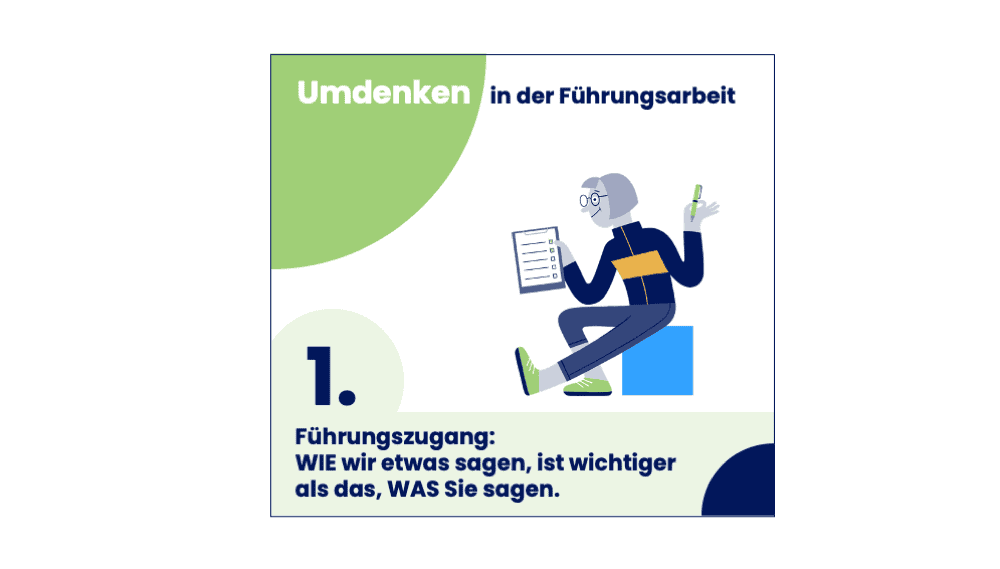
HOW we say something is more important than WHAT we say.
By now, it’s common knowledge that the most important aspects of communication are nonverbal. But let’s be honest: How often do you consciously pay close attention to these crucial details of nonverbal cues? Misunderstandings often arise because we focus so much on what we’re talking about that we completely overlook the actual process of communication.
Here's a little experiment: Imagine asking the leaders around you the following questions. How would they respond?
Have you ever …
- Have you ever had a conversation with someone and wondered, “What’s really going on here?”
- Have you ever heard someone say, “I don’t like your tone”?
- Have you ever felt misunderstood, as if someone had completely misinterpreted what you said?
- "mixed messages" because someone said one thing, but their body language conveyed something completely different?
- Have you been presenting your content more and more forcefully without achieving even the slightest effect in the way you intended?
- Do you feel the desire to reach a much wider audience in a lecture or presentation?
How well do the leaders around you communicate? How does this affect employee engagement, retention, customer service, and team morale—and perhaps even the culture of the entire company? What would you like to see change in this regard? If you had the tools to specifically address these challenges, what could that mean for your company, the culture around you, and the impact of your products and services in relation to your brand message?
A shift in attitude toward leadership can make a real difference here. We’ll now introduce you to the first of eight leadership approaches (“mindsets”) that can significantly improve a leader’s effectiveness.

A New Approach to Leadership – Leadership Insight #1: HOW we say something is often more important than WHAT we say.
Since nonverbal communication takes precedence over content, misunderstandings are inevitable if we focus on the WHAT and, in doing so, increasingly disregard the HOW—that is, the manner in which the actual communication takes place.
Focus more on the communication process, and you can significantly increase the impact of your message and the quality of your communication.
The Currency of Communication: The Key to Building Relationships and rapport
Think of currency as “legal tender for the exchange of interactions between people.” This exchange ultimately revolves around the “HOW” of communication. If you strike the right “note” with someone—or are on the same wavelength as them—it makes a huge difference: You’ll notice that this person is actually listening to you and engaging with what you have to say.

The Six Currencies of Communication
In the Process Communication Model®, we identify six “communication currencies” that people use to interact with one another. Below, you’ll find the appropriate behavior for each currency to help you build a relationship and rapport with the person you’re interacting with:
Compassion
Show that you care about others and that people can feel safe and comfortable around you.
Logic
Be logical and help others understand things so that what you say makes sense from a rational perspective.
Humor
Be energetic, cheerful, and spontaneous.
Imagination
Make sure you have enough space and time to think.
Values
Establish relevant connections to values, beliefs, and principles.
Initiative
Get things moving and ensure decisions are made quickly.
You can identify a person’s preferred currency in communication by paying attention to how they communicate. Use the table above as a guide. Then you can adjust your energy so that you’re both on the same wavelength, thereby fostering a better connection and relationship with one another.

The Power of Communicative Agility
Neurobiological studies have shown that people who receive a message in their preferred currency are more likely to pay attention, remember the message's content, respond positively to it, and feel better as a result.
Here are just a few areas where leaders can actively use the PCM framework to enhance the effectiveness of their leadership:
- Improve the quality of the responses to your emails.
- Increase engagement in your meetings.
- Improve your relationships with others—even in “difficult” situations.
- Expand your ability to leverage your influence as a leader.
Agile communication is a choice
Agile leaders make a conscious decision to tailor their communication specifically to the person they’re speaking with, thereby building a significantly better relationship. They develop the ability to authentically infuse each of the six currencies with energy. How does this look in your organization? Are you already equipping your leaders with these leadership skills?
But am I still being authentic then? Let’s not confuse discomfort with a lack of authenticity. The agility in communication I’ve mentioned allows you to view behavior differently, demonstrate more of your own potential, and identify significantly more options for action by experiencing and utilizing your entire personality as a leader—not just a small part of it. Even if it feels uncomfortable at first and sounds challenging, this form of agility is an enormous advantage in leading people.
Change your mindset to unleash even more leadership potential
The application of the PCM framework in communication and leadership is the focus of one of the eight modules in our PCM Leadership Seminar Program. Leaders learn how to …
- be able to connect with others more quickly and easily,
- improve their empathy and build lasting trust, and
- can deepen their rapport and have a positive influence on others.
Get in touch with our PCM and leadership experts to learn more about how PCM can help your leaders effectively shape and further optimize the critical intersection between communication and personality.

Why can PCM leadership seminars make a difference for you?
Social competence is arguably the most important trait of a good leader: the ability to build relationships, engage with others, resolve conflicts, and motivate people are essential leadership qualities. Today’s leaders must cultivate their self-confidence and communication skills in order to succeed in an extremely diverse, global, and virtual environment.
The PCM Leadership Seminar Program is a collection of learning and practical modules that use the Process Communication Model® to address the most common and important questions in day-to-day leadership.
Managers will gain a better understanding of how their own personality influences their role and effectiveness as leaders. They will learn how to tailor communication and motivation strategies so that all personality types in the workplace are motivated to contribute. They will also learn how to strategically leverage personality diversity to the fullest extent possible.
Middle managers and those new to their roles will learn and apply key interpersonal and communication skills to enhance their effectiveness in addressing a variety of leadership challenges, such as communicating more effectively, managing performance and motivation, handling miscommunication and conflict, building trust and engagement, and practicing self-care.
Our leadership and PCM experts can help you identify your leadership development needs and design the program that’s exactly right for your goals. Find a PCM expert near you here.
Copyright Notice:
Originally published on February 15, 2023, by Nate Regier, nextelement.com – translated and adapted by Uwe Reiner-Kolouch, KCG